Most founders don’t fail because they can’t build.
They fail because they build the wrong thing for way too long, then call it an MVP and wonder why nobody cares.
If you have ever opened a notes app, dumped 40 feature ideas into it, and felt pressure to ship everything “so it looks real,” you are not alone. But that mindset is exactly how timelines slip, budgets get messy, and teams end up arguing about features instead of learning from users.
So what is an MVP, really?
In this guide, we will break down what MVP is and what it is not, how to spot the difference between “useful” and “nice to have,” and how to define a first version you can ship, measure, and improve without wasting months.
An MVP is the smallest version of a product that real people can use, so you can learn what actually works. It’s not about shipping fast. It’s about testing one clear assumption with a minimum viable product you can measure.
What An MVP Really Mean?
The MVP meaning gets misunderstood because people treat “minimum” like a shortcut and “viable” like an afterthought.
Here’s the practical definition.
An MVP is the smallest release that lets a real user complete a real task and gives you a clear signal about whether you should keep going.
- Minimum means you cut everything that does not help prove the main idea.
- Viable means it actually works for the user without handholding.
- Product means someone can use it end-to-end, even if it is basic.
A helpful way to think about it is this. An MVP is not built to impress. It is built to answer one high-stakes question.
The One Question Your MVP Should Answer
Pick one question that matters most right now, for example:
- Will people do this more than once?
- Will they pay for it or ask for access?
- Will they switch from their current workaround?
- Will they keep coming back after the first try?
What an MVP is Built to Prove
Most MVPs fail because they are built to “launch a product,” not to prove anything specific. When the goal is vague, everything feels important, and the scope quietly balloons.
A strong MVP is built to prove a small set of truths about your market and your users. Not opinions. Not compliments. Real signals you can track.
Here are the most common things an MVP should prove.
1) The Problem is Real and Painful
People might agree that your idea is interesting. That does not mean they need it. Your MVP should confirm the pain exists, shows up often, and is strong enough that users will change their behavior to solve it. Look for evidence that they already have workarounds like spreadsheets, DMs, manual processes, or paid tools. If the problem is truly painful, they will describe it with urgency and be willing to try something new, even if it is basic.
2) You Have the Right User in Mind
An MVP works best when it is built for one clear audience, not “everyone who might use this.” When you mix personas, you get mixed results, and you will not know who the product is really for. This pointer is also where most teams overbuild because different users request different things. Keeping the audience tight helps you decide what stays out. That clarity is the difference between learning quickly and building endlessly.
3) Your Value Becomes Obvious Quickly
A strong MVP should prove that users understand the value without a long explanation. If the product needs a demo call to make sense, you will struggle to measure real pull. Your early experience should make the main outcome obvious within minutes, not days. This is where MVP features matter. They should create a clear first win, like completing the key action, reaching the first outcome, or seeing a practical payoff that makes users want to return.
4) People Adopt It, Not Just React to It
Positive feedback is easy to collect. Real adoption is harder, and that is the point. This is where founders get stuck on what is an MVP because they confuse compliments with validation. Your MVP should prove behavior, not opinions. Are users completing the core action without reminders? Do they come back within a week? Do they invite someone else? Do they ask for access again? When you see consistent behavior, you have something worth building on.
5) You Can Measure Success Before Building More
If you cannot measure outcomes, you will keep adding features as a substitute for clarity. Decide your success signal before you ship, then track it from day one. Common MVP success signals include:
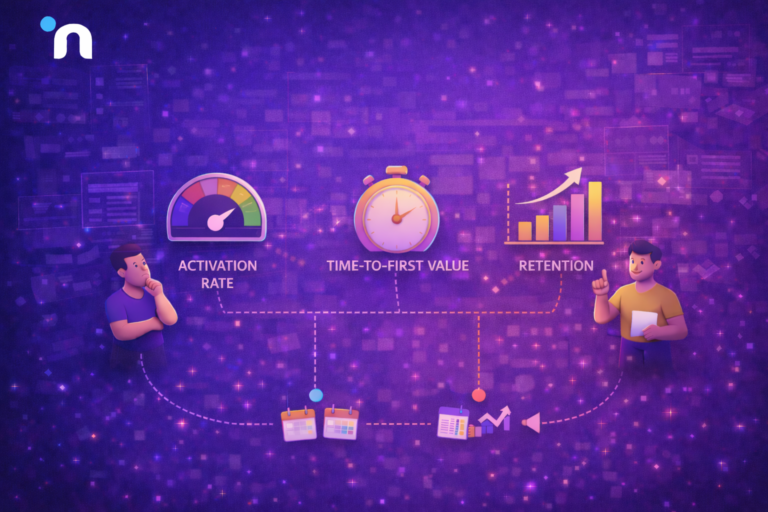
- Activation rate
- Completion rate
- Repeat usage over a week or two
- Conversion to a request, booking, or payment
Pick one or two that match your goal. When you track the right signals early, you can improve the MVP based on reality instead of guesswork.
What an MVP is Not
Knowing what an MVP is helps, but knowing what it is not is what keeps your scope from spiraling. Most teams don’t overbuild because they love extra work. They overbuild because they use “MVP” as a label for anything early, even when it’s actually a prototype, a technical experiment, or a half-finished product.
That mix-up leads to messy decisions. You measure the wrong things, collect the wrong feedback, and end up adding features instead of learning.
This is the fastest way to spot scope creep before it starts.
To keep your first release focused, separate your MVP from these common lookalikes.
1) Not a Full Product
An MVP isn’t your final product in “small mode.” It’s not a feature list trimmed by 20% and shipped early.
A full product aims to cover lots of scenarios, edge cases, and user types. An MVP aims to prove one thing. When you try to make the first release feel complete, you end up building a lot and learning very little.
Quick gut check: if you’re adding MVP features mainly to “look professional,” they probably don’t belong in the first release.
2) Not a Prototype
A prototype helps you explore an idea. It’s great for testing flows, screens, and whether people understand the concept.
But most prototypes don’t hold up in real usage. They can’t reliably handle real behavior over time, and they often work best when someone is guiding the user through it.
That’s the key difference in the MVP vs prototype debate. A prototype helps you show the idea. An MVP helps you prove people will actually use it.
3) Not a Proof-of-Concept
A proof-of-concept answers a technical question. Can we build it? Can the integration work? Can the system handle the load?
That step can be useful, especially when the feasibility is unclear. But it doesn’t prove demand. You can have a working proof of concept and still have no adoption.
That’s why MVP product development is a different job. An MVP is built to test user pull through real usage, not just confirm that something is technically possible.
4) Not a Beta of Everything
A beta is often treated like a dumping ground. Teams toss in multiple features, half-finished ideas, and experiments, then ask users for feedback.
The result is noisy input and unclear decisions because users don’t know what they’re supposed to judge. A focused beta can work when it stays true to one promise. A messy beta turns into a grab bag that produces confusion instead of learning.
MVP vs. Prototype. Proof-of-Concept
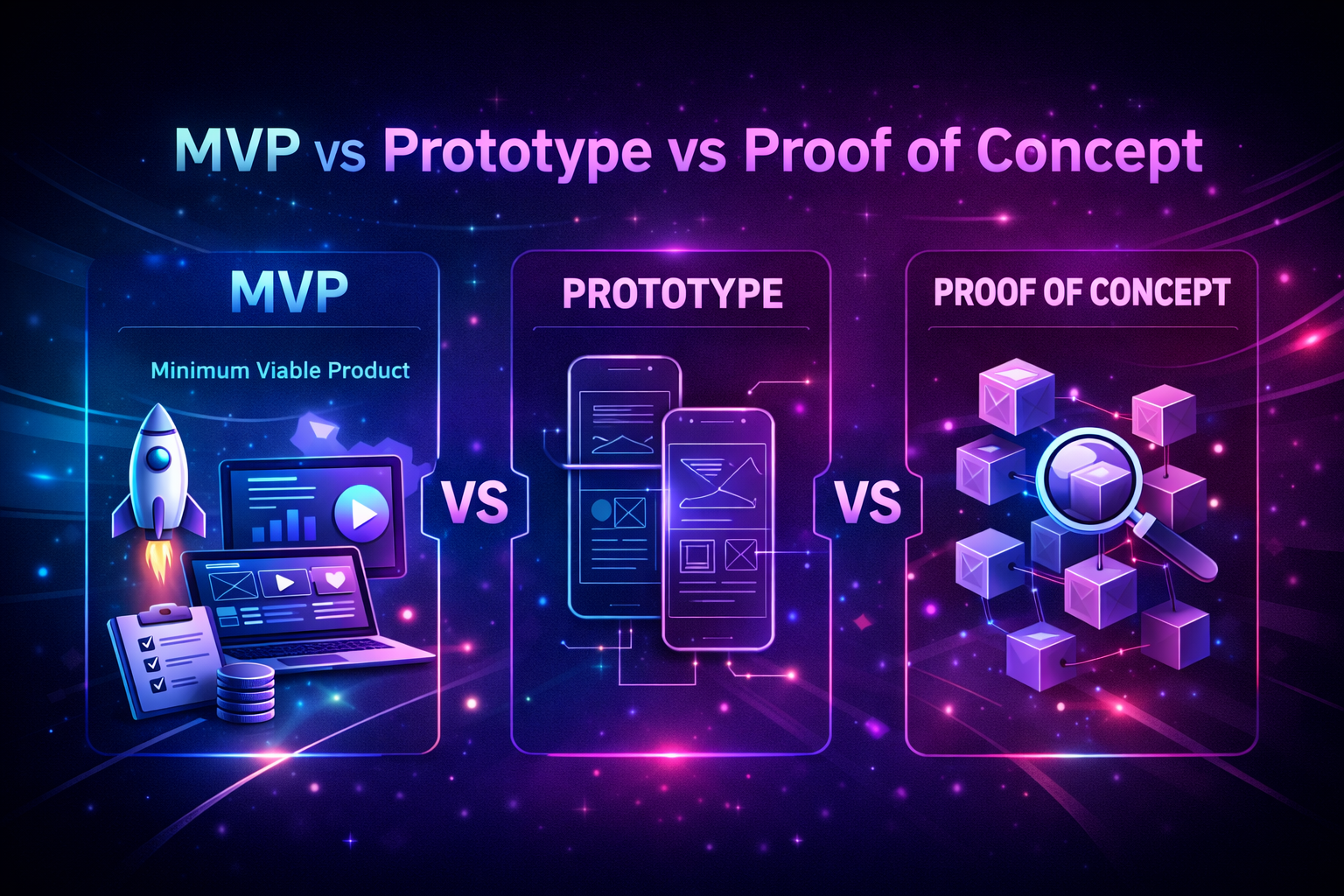
These terms get tossed around like they mean the same thing, mostly because they all happen early. But they solve different problems. When teams treat them as interchangeable, they end up judging progress the wrong way. A prototype can look impressive and still prove nothing about adoption. A proof of concept can work perfectly and still have no market pull. And an MVP can fail simply because it was never built to test one clear thing.
If you are trying to understand what is an MVP, this comparison is the quickest way to spot where you actually are, and what you should build next.
| Type | What’s It For | What You Build | Who Uses It | What Success Looks Like |
| Prototype | Test the idea and the flow | Screens, clickable demo, and rough UX | You and early testers | People understand it and can navigate the concept |
| Proof of Concept | Test technical feasibility | A working technical experiment | Mostly engineers | The risky technical part works in practice |
| MVP | Test user pull through real usage | A small usable product | Real users | Users adopt it, return, or pay, and you can measure it |
The Easiest Way to Choose
Start with the uncertainty you’re trying to remove.
- Exploring whether the user journey makes sense calls for a prototype
- Proving that a risky technical piece can work points to a proof of concept
- Learning whether people will actually use it and come back is where an MVP fits
This also clears up the MVP’s meaning in practice. It’s less about “a small product” and more about “a focused test you can measure.”
Common Real-World Examples
These examples make the difference easier to spot in real projects, especially when teams are moving fast, and everything gets labeled “MVP” by default.
- Clickable onboarding screens in Figma that test whether users understand the flow are a prototype.
- A payment, AI, or third-party integration test built to confirm feasibility is a proof of concept.
- A basic release that users can sign up for and complete the main action in is an MVP.
Quick Sanity Check
When it’s not obvious what stage you are in, these checks help you label the deliverable correctly so you measure the right thing.
- Needing a live walkthrough for it to make sense usually means prototype territory.
- Seeing only technical feasibility usually means proof-of-concept territory.
- Getting end-to-end usage with measurable behavior usually means MVP territory.
When You Should Build an MVP
An MVP makes sense when you’re ready to learn from real usage, not just refine an idea in theory. It’s the right move when you can clearly describe who the product is for, what problem it solves, and what success looks like after someone tries it. Without those basics, an MVP turns into a rushed build with blurry outcomes.
Here are the signs you are in MVP territory.
1) You Have a Clear User and a Clear Pain
You can describe the user in one sentence and the pain in one sentence. Even better, you can point to the workaround they already use. If you’re still debating whether the user is “small businesses, enterprises, and creators,” the scope won’t stay tight. MVP in startups works best when the audience is specific enough that you can predict what they’ll try to do first.
2) You Can Name the Assumption You Want to Test
A strong MVP is built around one make-or-break assumption. For example, “Teams will invite a second person within a week,” or “Shops will pay to avoid manual tracking.” If you can’t name the assumption, you’ll ship something broad and then interpret every piece of feedback as a reason to add more. That’s the real MVP meaning in practice: one focused bet you can validate through behavior.
3) You Can Reach Real Users Quickly
The best plan fails if you can’t put the product in front of the right people. You don’t need a massive audience. You need access to a small group of users who actually feel the problem and can try it in a realistic context. If your only plan is “we’ll run ads later,” you may want to start earlier with something lighter. This is where MVP vs prototype helps: a prototype buys clarity when access and testing conditions are limited.
4) You Can Support Feedback Loops
MVPs don’t work as “build it and wait.” They work when you can observe usage, talk to users, remove obvious friction, and iterate in short cycles. That means having time for follow-ups, a way to capture feedback, and a way to ship updates without drama. MVP product development becomes much easier when iteration is part of the plan, not an afterthought.
5) You Know How You Will Measure Success
Before you build, define the one or two signals that prove you’re on the right track. This could be repeat usage, completion of the core action, retention over a week, or conversion to a request or payment. Without measurement, it’s too easy to mistake activity for progress and keep building in circles. This is also why picking MVP features is a measurement decision as much as it is a product decision.
When You Shouldn’t Build An MVP
An MVP is a great tool, but it’s not the right first step in every situation. Sometimes the problem is still too vague, the audience is too broad, or the risk is less about product and more about access, trust, or compliance. In those cases, forcing an MVP usually leads to noisy feedback and wasted effort.
Here are a few times it’s smarter to pause and do something else first.
1) The Problem is Still Unclear
If you can’t explain the problem without drifting into multiple use cases, you’re not ready for an MVP. You’ll end up building a scattered first release and calling the feedback “confusing.” This is where MVP meaning gets distorted. The MVP is supposed to test one clear assumption. When the assumption isn’t clear, you’re better off doing sharper problem discovery and user interviews before building anything.
2) You Can’t Reach the Right Users
You don’t need scale, but you do need access. If you have no realistic way to put the product in front of people who actually feel the pain, an MVP won’t give you trustworthy learning. You’ll end up testing on the wrong audience, then changing the product based on the wrong signals. In that scenario, MVP in startups often becomes a distraction. Start with a tighter outreach plan or a smaller prototype shared in a controlled way.
3) Compliance, Safety, or Trust is the Real Barrier
Some products can’t be tested with a “basic version” because the risk isn’t just feature quality. It’s user safety, legal exposure, data privacy, or trust. If your product requires strict compliance or handles sensitive data, you may need more groundwork before you release anything publicly. That doesn’t mean no MVP. It means your MVP must be shaped around safe constraints, or you need pre-work before shipping.
4) You Are Trying to Validate Too Many Ideas At Once
If the plan is to test multiple user types, multiple problems, and multiple workflows in one release, you won’t learn anything clearly. You’ll collect feedback that conflicts and points in ten directions. This is where MVP features quietly explode. A better move is to narrow the promise and test one job to be done first, then expand after you see real usage.
5) You Are Not Set Up to Learn
An MVP without iteration is just a small product. If you can’t track usage, talk to users, and ship improvements in short cycles, your learning window closes fast. You’ll get a mix of opinions and edge cases, and you won’t know what matters. This is why MVP product development should include an iteration plan from day one, even if it’s basic. Otherwise, you’ll be guessing and building in circles.
The Three Traits of a Strong MVP
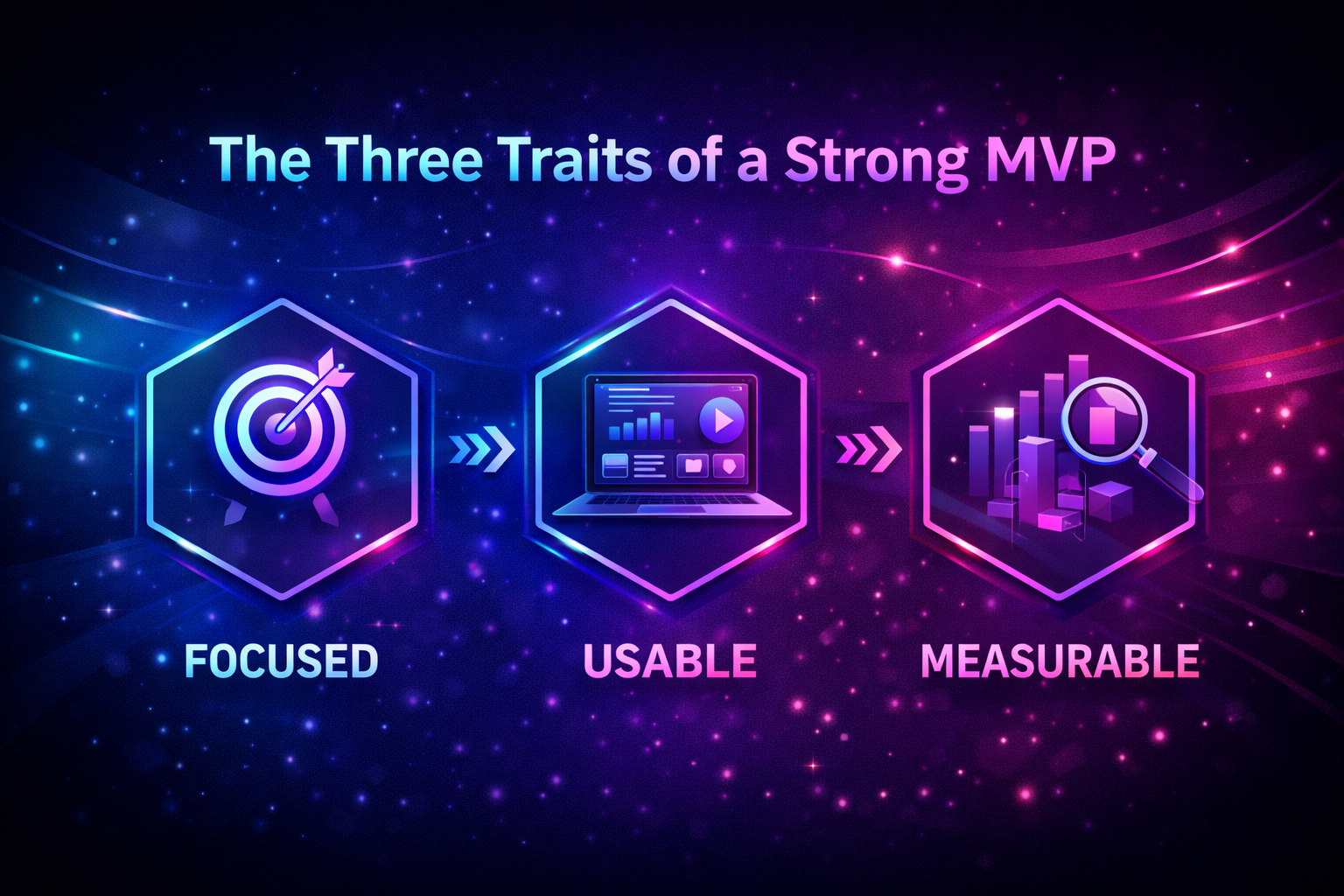
A strong MVP isn’t defined by how small it is. It’s defined by how clearly it proves something important. The best MVPs don’t try to cover every scenario or satisfy every stakeholder. They pick one meaningful job, remove distractions, and create a first version that real users can actually try.
This matters because an MVP has two jobs at the same time. It has to be simple enough to ship without a long build cycle, and solid enough that the feedback is trustworthy. If it’s too rough, people won’t use it. If it’s too broad, you won’t learn what caused the outcome.
With that in mind, there are three traits that consistently show up in MVPs that produce clean learning.
Focused
A good MVP makes one clear promise to one clear user. That focus keeps decisions simple because you’re not trying to satisfy competing workflows in the same release.
A practical way to lock focus is to write a one-line promise you can’t wiggle out of:
“Help [specific user] do [one job] without [main friction].”
Then scope the MVP around that job only. If a feature doesn’t directly support that job or help you prove it matters, it goes into “later.” If you can’t name the single action that represents success, your MVP is probably trying to do too much.
Quick test: If you need a long explanation for what the product does, it’s not focused yet.
Usable
“Early” doesn’t mean confusing. A strong MVP should work without handholding, otherwise your feedback becomes “I don’t get it” instead of “this solves my problem.”
Aim for a first-time user to complete the core action in one sitting without a call. That doesn’t require perfect design. It requires obvious next steps, fewer decisions, and no dead ends. Remove anything that creates hesitation: unclear buttons, extra form fields, too many options, or an onboarding flow that feels like homework.
Quick test: Ask someone unfamiliar with the product to try it silently. If they get stuck twice, the MVP isn’t usable enough to learn from.
Measurable
An MVP should produce signals you can track, otherwise you end up arguing based on vibes.
Pick one primary success signal tied to the core job, then define what “good” looks like before you ship. For example:
- Percentage of users who complete the core action
- Time to first value
- Return usage within 7 days
- Request for access, demo, or payment
Also, decide what failure looks like, so you don’t keep building forever to “give it one more chance.”
Quick test: if you can’t answer “what would make us stop or change direction,” you are not measuring, you are just hoping.
Quick Checklist
Here’s a quick pre-flight check before you build or ship. It’s meant to catch the most common MVP traps early, while they’re still easy to fix. If you can’t confidently tick these off, your MVP is probably either too broad to learn from or too rough to test properly.
- One user, one main job: You can name who it’s for and the single outcome they came for.
- Core action works end-to-end: A first-time user can complete the main task without a call.
- Success signal defined before launch: You know exactly what result would count as a win.
- Tracking is in place: You can see the key actions and outcomes without guessing.
- A clear “stop or pivot” trigger: You’ve decided what result would mean changing direction.
- Feedback loop planned: You have a plan to talk to users and ship improvements quickly.
How to Define Your MVP Scope in One Hour
This is the part most teams skip, then spend weeks “figuring it out in the build.” A one-hour scope session won’t make every decision for you, but it will do something more important. It will force clarity on what you’re testing, what you’re shipping, and what you’re deliberately leaving out.
If you’re still trying to nail down what is an MVP, this exercise is the fastest way to shift from vague ideas to a focused first release you can actually measure.
Set a timer. Grab a doc. Do this in order.
Step 1: Pick One User and One Problem
Write this in plain language, not market-y language.
- User: Who exactly is this for
- Problem: What annoying thing keeps showing up for them
- Current workaround: What are they doing today instead
If you can’t name the workaround, you’re likely guessing.
Step 2: Write the Promise in One Sentence
This sentence keeps your MVP from becoming a feature museum.
Use this format:
Help [user] do [job] without [main friction].
Example:
Help independent shop owners book repeat customers without chasing messages across multiple apps.
If you need two sentences, it is usually not focused yet.
Step 3: List User Actions, Not Features
Features create debates. Actions create clarity.
Write the steps a user must take to get value.
For example:
- Sign up
- Create something
- Upload or add data
- Invite someone
- Book, request, or pay
- Get confirmation
Now you have a workflow. Features come later.
Step 4: Mark Must-Have vs Later
Here’s the rule that keeps this honest:
Must-have means the MVP test fails without it.
Later means it helps, but it’s not required to prove the main thing.
A quick way to decide:
If the user can still reach the first meaningful outcome without it, it’s “later.”
Step 5: Choose One Success Signal
Pick one signal that proves your promise is working. Not ten.
Examples that work well for MVPs:
- Time to first value
- Completion of the core action
- Return usage within 7 days
- Request for access, booking, or payment
Decide what “good” looks like before launch, even if it’s a rough benchmark.
Step 6: Cut the Anxiety Features
These are the features people add to feel safe, not to learn.
Common anxiety features:
- Dashboards before you have usage
- Roles and permissions for a tiny user set
- Complex settings pages
- Multiple workflows for multiple personas
- Beautiful polish that delays testing
If it doesn’t help you prove the main assumption, it goes to “later.”
Step 7: Write Your MVP Scope as a Short List
End the hour with two lists.
MVP includes
- 3 to 7 bullets max
- Written as outcomes or actions, not feature names
MVP excludes
- The things you are intentionally not building yet
- This protects you when new ideas pop up mid-sprint
Common MVP Mistakes that Waste Months
Most MVP trouble isn’t technical. It’s a decision problem. Teams start with a good idea, then slowly dilute it with extra features, extra audiences, and extra “just in case” work until the MVP becomes too big to learn from.
Here are the mistakes that quietly burn time.
1) Building for Multiple Personas in the First Release
This usually starts with good intentions. Someone says, “Let’s support two user types from day one,” and suddenly every workflow has to branch. That’s how the first version turns into compromises, extra screens, and feedback that points in opposite directions. In MVP in startups, the fastest way to get a clean signal is choosing one user to learn from first, then expanding once you have proof of what actually matters.
2) Adding Features to Reduce Anxiety
This is the quiet killer. Teams add dashboards, settings, roles, permissions, and “nice-to-have” flows because it makes the product feel more finished. The problem is that those additions rarely help validate the main assumption. In fact, they often slow learning down. Pendo’s analysis of product usage data found that 80% of features in the average software product are rarely or never used, which is a strong reminder that extra MVP features can easily become dead weight instead of value.
3) Treating Positive Feedback Like Validation
Hearing “This is cool” feels good, but it’s not proof. People are polite. They also don’t want to hurt your feelings. The real test is behavior:
- Do they complete the core action?
- Do they return on their own?
- Do they ask for access again?
When you anchor decisions on compliments, you drift away from outcomes and start building for approval instead. That’s not the MVP’s meaning. The whole point is to prove something through usage.
4) Confusing Adoption with Activity
A lot of teams ship, see a few signups, maybe run a few demos, and assume traction is happening. Then they keep building. The better question is whether the product creates repeat behavior without you pushing it. If you’re still wondering what is an MVP, it helps to remember this: an MVP is a test of pull, not a test of how loudly you can launch
5) Shipping Without Clear Measurement
If success isn’t defined before launch, every result becomes easy to interpret as “not enough yet.” That’s how teams end up building forever. Decide what success looks like, pick one primary metric, and track it from day one. A minimum viable product doesn’t need a complex analytics setup, but it does need a clear signal you can trust.
What to Build After the MVP
Once the MVP is live, the next move isn’t “add more features.” The next move is to read the signal, fix what blocks adoption, then expand with intent. This is where teams either turn early learning into momentum or drift into feature overload.
Here’s a clean way to decide what comes next.
Step 1: Look at Behavior First, Not Feedback
Feedback is useful, but behavior is cleaner. Start with what people actually did:
- Where did they drop off?
- What did they repeat?
- What did they ignore?
- What did they try to do that you didn’t support?
If users aren’t reaching the first outcome, your next build is usually friction removal, not new features.
Step 2: Improve the Path to First Value
Before adding anything new, tighten the journey to the main action. Most of the time, the “next build” is removing friction around MVP features, not expanding the scope.
- Fewer steps to the main action
- Less setup required
- A clearer next step after each action
- Better defaults so users aren’t forced into too many decisions
Step 3: Decide What You Are Optimizing For
Before expanding, pick the next target. One target per cycle keeps decisions clean:
- More users completing the main action
- More users returning
- More teams inviting others
- More users asking to pay or upgrade
If you try to improve everything at once, you’ll struggle to know what caused the improvement.
Step 4: Add the Next Feature Only If It Removes A Blocker
New features should earn their place by removing a repeated obstacle tied to adoption. This is also a helpful lens when you’re stuck in MVP vs prototype debates, because it forces you to build based on real blockers, not guesses.
- Removes a common obstacle users hit
- Supports a repeated request tied to the main job
- Helps users get value faster
- Makes the product workable in a real setting (export, notifications, basic roles)
Step 5: Tighten Quality Control Around What People Actually Use
You don’t need to perfect the whole product. Protect the few flows that create the outcome, because that’s where trust is won or lost with a minimum viable product.
- The main workflow
- The top 2 to 3 screens users touch most
- The actions tied to your success signal
Step 6: Start Building the Second Loop
Many MVPs only support a first-time win. The next phase is creating a reason to return, so usage becomes consistent instead of occasional. This is where MVP product development shifts from “first release” to “repeatable value.”
- Reminders and follow-ups
- Saved state, so work continues easily
- A reason to return weekly
- A simple habit trigger that fits the job
If you get the loop right, features feel like upgrades instead of patches.
Conclusion
An MVP is not a smaller version of your dream product. It is a focused way to learn what truly matters before you invest months into building. If you have been asking what is an MVP, the answer comes down to clarity. One user. One job. One success signal you can measure. Keep the scope tight, ship something usable, and let real behavior guide what comes next. That approach protects your time, your budget, and your momentum. If you want a second opinion on your plan, Novura can review your scope and help you prioritize the right MVP features for a first release.
FAQs
Q1. What is a good MVP budget?
A good MVP budget is whatever it takes to ship one usable workflow and measure real usage. If the budget keeps rising, the scope is usually too wide.
Q2. How many features should an MVP have?
As few as possible, but enough to complete the main job from start to finish. If a feature doesn’t help test the main assumption, it goes into “later.”
Q3. Does an MVP need a mobile app?
No. Build where your users already are and where updates are fastest. Add mobile once you see repeat usage and a clear reason for it.
Q4. Can an MVP be built with no code?
Yes, as long as users can complete the main job without heavy manual help behind the scenes. If manual steps dominate, your learning gets noisy.
Q5. What is the difference between MVP and beta?
An MVP is a focused test designed to prove one thing through usage. A beta is a release stage that can include an MVP, as long as it stays focused and measurable.
Q6. How do I know my MVP succeeded?
Your MVP succeeded if it produced a clear signal that tells you what to do next. Common signals include:
- users completing the main action
- repeat usage within 7 to 14 days
- requests to pay, upgrade, or invite others