Most people think they have a tool problem.
They do not.
They have a prompting problem.
You can use the best model in the world and still get bland output if your prompt sounds like this.
“Act as an expert. Write me something great.”
That prompt is basically a shrug.
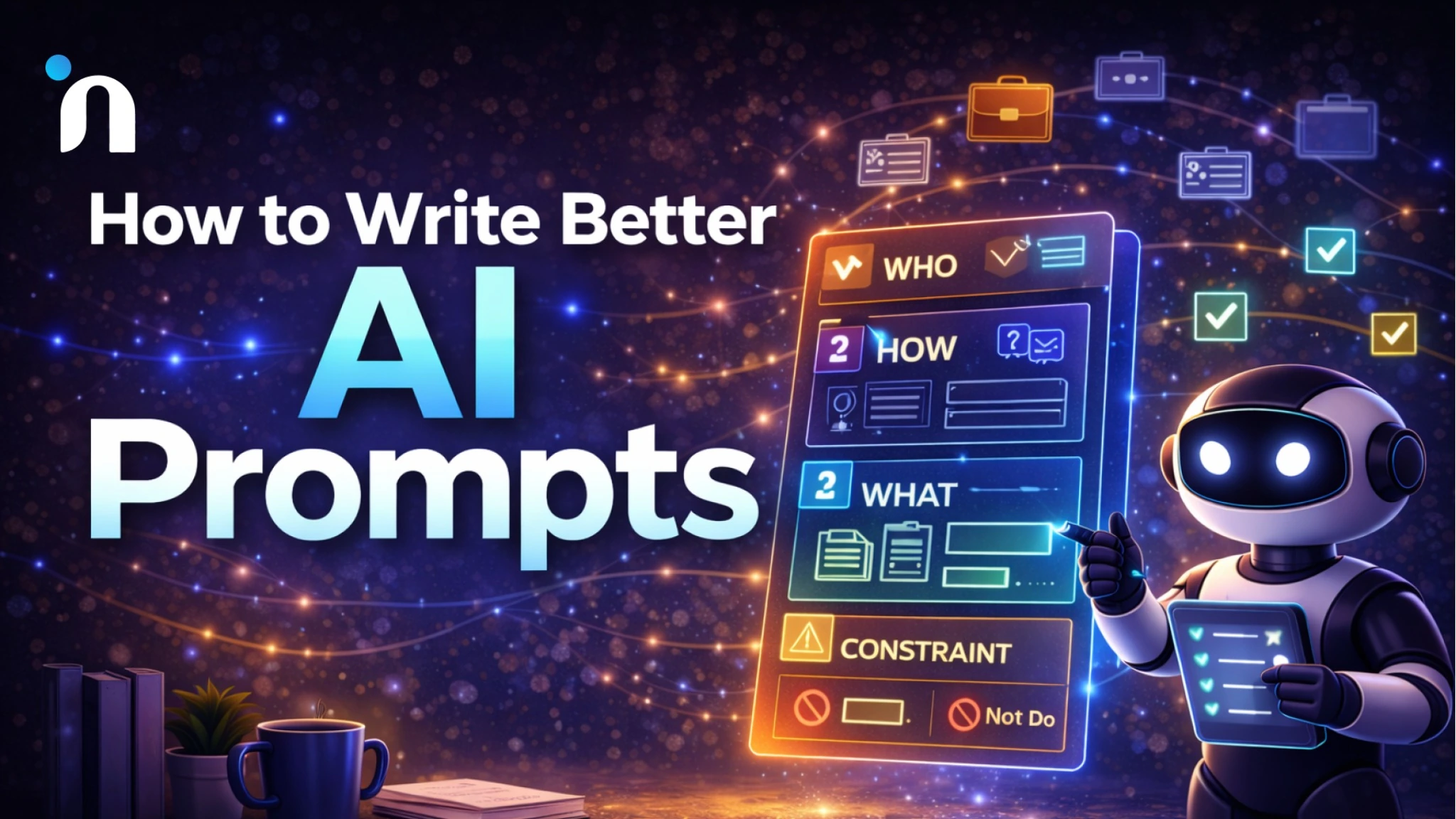
If you want to learn how to write better AI prompts, the fastest upgrade is a simple method I use constantly. WHO, HOW, WHAT.
WHO you want the AI to be.
HOW you want it to think.
WHAT you want it to deliver.
No drama. No prompt wizardry. Just clear instructions that make the output instantly sharper.
Alright, let’s retire “act as an expert” and replace it with something that actually works.
The Problem with “Act as an Expert” Prompts
“Act as an expert” is not a prompt. It is a vibe.
It gives the model almost nothing to work with, so it fills in the blanks with the safest possible answer. That is why you get writing that sounds polished but empty.
Here is what is missing.
- Expert in which domain
- Expert for which audience
- Expert with what constraints
- Expert output in what format
When those details are unclear, the output becomes generic on purpose.
If you want to improve ChatGPT responses, you do not need longer prompts. You need clearer ones.
Let’s upgrade this from “trust me bro” to a three-part prompt that actually gives direction. WHO, HOW, WHAT.
The WHO HOW WHAT Method

This is the simplest AI prompt framework I have used that consistently upgrades output without making your prompts long and nerdy.
If you have been wondering how to write better AI prompts, it usually comes down to one thing. Stop asking for vibes and start giving direction.
It forces clarity in three moves.
WHO
Who should the AI be for this task? Not just an expert. More like a real person with a job.
A senior product marketer in B2B SaaS
A customer support lead for a repair shop
A CTO who hates fluff
That is role specificity. It is the start of a good prompt structure.
HOW
How should it think? What approach should it use? What rules should it follow?
- Use a step-by-step approach
- Ask two clarifying questions first
- Give options and tradeoffs
- Keep it practical
This is where prompt engineering basics quietly matter. You are guiding the reasoning, not just requesting an answer.
WHAT
What do you want back? Identify the exact deliverable you want.
Is it:
- A 120-word LinkedIn caption
- A bullet list of next steps
- A table with pros and cons
- Three subject lines and one email
This is where you stop vague output. You are giving an output brief, not a wish.
This method also slots nicely into a practical AI mastery roadmap when you want your skills to compound over time.
Next, we break down each part with examples you can copy and use immediately.
“WHO” is Role Prompting that Works
Most people write Act as an expert and call it a day.
Real role prompting is more like casting a character for a scene. The more specific the role, the less the model has to guess.
A good WHO has three parts.
- The job
- The domain
- The personality or standard
Here are a few that work well.
Weak WHO
Act as an expert marketer.
Strong WHO
You are a senior B2B SaaS product marketer. You write clear, punchy copy for founders and operators. You hate fluff, and you prefer short sentences.
Strong WHO for Ops Work
You are a customer support lead at a repair shop. You write calm, clear responses that reduce back-and-forth. You keep the tone friendly but firm.
Strong WHO for Strategy
You are a CTO reviewing a proposal. Your job is to spot risk, scope creep, and hidden complexity. You prefer direct language.
This is why role prompting matters. It gives the model a point of view, not just a label.
Next, we add HOW, which is where you tell it how to think, so the output stops being generic.
“HOW” is Where You Control the Thinking
If WHO is the character, HOW is the direction.
This is the part that separates decent output from the kind that makes you go, “Yep, that is what I meant.”
And honestly, this is where how to write better AI prompts becomes a real skill. You stop requesting. You start steering.
A strong HOW usually includes at least one of these.
Add Prompt Constraints
Constraints are the guardrails that keep the answer useful.
- Limit the length
- Include or exclude certain points
- Use a specific tone
- Stay within a certain budget or time window
That is how you avoid the 900-word essay when you only needed a reply.
Ask for Questions First
If information is missing, make it ask.
“Ask me 2 questions before you write.”
That line alone upgrades output because the model stops guessing.
Force a Simple Reasoning Approach
Tell it the approach you want.
- Give me 3 options and the tradeoff of each
- List risks first, then recommendations
- Start with a short plan, then expand
This is simple prompt constraints plus direction, and it massively improves the result.
Next is WHAT, which is where you lock the output format, so you stop getting random structure every time.
“WHAT” is the Output Format Prompt
This is the part that saves you from random results.
If you do not tell the model what to deliver, it will pick a format for you. Usually, a generic mini essay with smooth transitions and no urgency. And if the tone still comes out overly polished, a simple fix for robotic writing helps you make it sound like a person again.
A strong WHAT is basically a shopping list for the output.
- Format
- Length
- Sections
- Tone
- What to avoid
Here are a few clean examples.
Example 1: Email Reply
Write a reply in 90 to 120 words.
Tone calm and confident.
Include 3 bullet points.
Avoid buzzwords and filler.
Example 2: Strategy Options
Give me 3 options in a table.
Columns are option, upside, downside, effort, and risk.
End with a recommendation and why.
Example 3: LinkedIn Caption
Write a LinkedIn caption in 120 words.
Use short lines.
One concrete example.
End with a punchy closing line.
That is an output format prompt. It tells the model exactly what done looks like.
The Copy-Paste Prompt Template

Cool, let’s bottle this up into a reusable prompt template so your future self can stop working so hard.
Use this as a fill-in-the-blanks prompt template. Copy it once, then tweak the brackets.
Template
WHO
You are a [role] in [domain]. Your style is [tone]. You care about [priority]. You avoid [things to avoid].
HOW
Before writing, ask me 2 questions that would make the answer more specific.
Then follow this approach [steps or framework].
Respect these constraints [length, time, budget, inclusions, exclusions].
WHAT
Deliver [format].
Length is [exact length].
Structure is [sections or bullets].
Include [must include].
Avoid [must avoid].
That is the whole method. Short, clear, reusable.
Now here is the cheat move. When you find a version that works, do not let it disappear into the void. Save it.
Now for the fun part, plug this into real tasks and watch the quality jump.
Prompt Examples for Real Work
If you are learning how to write better AI prompts, this is where it clicks. Same structure, different task. If you want a simple way to practice this daily, start with a quick 10-minute AI warmup and run one task through WHO, HOW, WHAT.
Example 1: A Client Email that Needs Clarity
WHO
You are a customer success lead. You write short, clear emails that reduce back-and-forth. Friendly, not fluffy.
HOW
Ask me 2 questions first. Then draft the email. Keep it under 120 words. Remove filler.
WHAT
Deliver 2 versions. One warm and one direct. Include a subject line for each.
Example 2: A Weekly Plan that is Actually Usable
WHO
You are a pragmatic project manager. You care about priorities, owners, and deadlines.
HOW
Ask 2 questions. Then propose a plan with tradeoffs. Use realistic time estimates.
WHAT
Deliver a table with task, owner, time estimate, dependency, and risk. End with the top 3 things to do first.
Example 3: Rewrite Something that Sounds Like a Robot
WHO
You are a sharp editor. You keep the meaning but make the writing sound human and specific.
HOW
Remove generic transitions and announcer phrases. Vary sentence length. Add one concrete example if missing.
WHAT
Deliver a rewritten version plus a short list of what you changed and why.
Example 4: Decision Support for a Messy Choice
WHO
You are a skeptical operator. Your job is to spot risk and hidden cost.
HOW
Ask 2 questions. Then give 3 options and the tradeoff of each. Be blunt about risk.
WHAT
Deliver in bullets. End with a recommendation and one sentence on what would change your mind.
Those are prompts for work that actually get used. Same skeleton, different costume.
Now we make this even easier by saving your best prompts, so you stop rewriting them every week.
Save Your Best Prompts So They Compound
This is the part people skip, and it is why they feel like they are always starting over.
They write a great prompt once, get a great result, then lose it forever in the scrollback.
So do this instead.
Build a tiny library of reusable prompts.
No fancy system needed. A doc, a notes app, a folder, whatever you already use.
Name Prompts By the Job to be Done
Not Prompt 7. Not Marketing prompt.
Name it like:
- Client email reply
- Weekly plan
- Rewrite to sound human
- Decision options with tradeoffs
- Meeting notes to action items
That way, you can find it fast when you are busy.
Add One Line On When to Use It
This sounds small, but it is the difference between a prompt you reuse and a prompt you forget. When you are in a rush, you do not want to reread the whole thing to remember why it exists. One line gives your future self instant context.
Example: Use this when I need a short email that reduces back-and-forth.
Now your good prompts stop being accidents. They become assets.
That is how you get consistent output and improve ChatGPT responses over time.
Next, a quick prompt checklist you can run in five seconds before you hit enter.
The Quick Prompt Checklist Before You Hit Enter
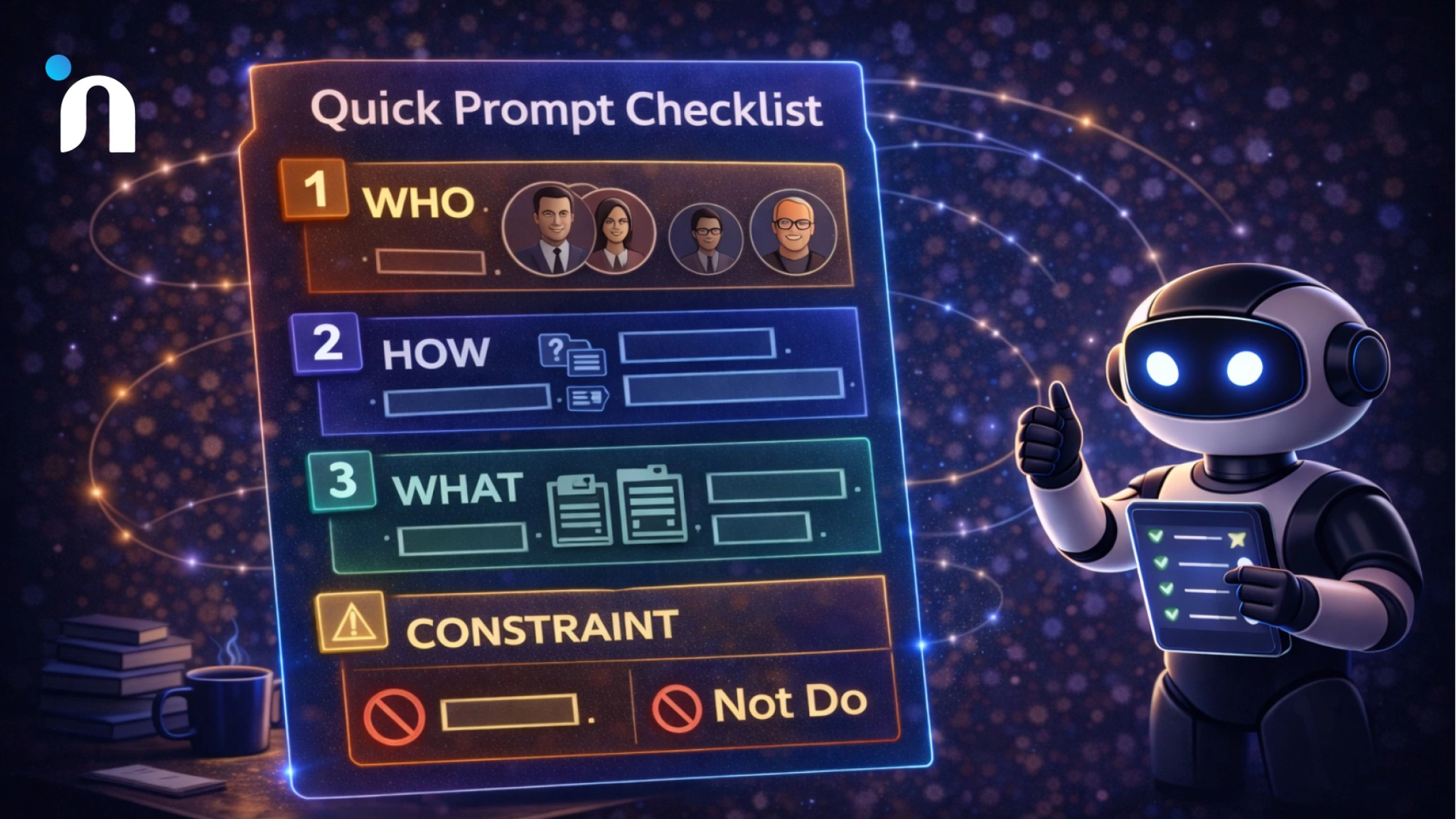
When I am trying to move fast, this is the little pre-flight check I run so I do not get a bland essay back.
If you are learning how to write better AI prompts, steal this. It takes five seconds and saves you a rewrite.
1) WHO is it Today
Not an expert. More like a real person with a job.
Senior product marketer. Support lead. Skeptical CTO. Whatever fits.
2) HOW Should it Think
Do I want steps? Options? Tradeoffs? A critique?
Also, did I tell it to ask 2 questions first so it stops guessing?
3) WHAT Do I Want Back
Email. Table. Bullet list. Script. Caption.
If I do not specify the format, it will pick one, and I will hate it.
4) One Constraint, Minimum
Word count. Tone. Must include. Must avoid. Time window. Budget. Anything.
5) What Should it Not Do
No fluff. No buzzwords. No press release voice. No filler.
That is the checklist. If I do all five, I almost always get a useful first draft.
Now, let’s land this with one simple rule you can remember the next time your fingers start typing “act as an expert.”
The One Rule to Keep in Your Head
If your prompt is vague, the output will be vague.
That is the whole game.
Any time your prompt feels like a shortcut, pause and add the missing clarity. WHO is doing this. HOW they should approach it. WHAT the deliverable should look like.
Give it a real role.
Give it a thinking approach.
Give it a clear output.
Do that consistently, and you will feel the difference fast. Cleaner drafts. Less back and forth. Less rewriting the same thing three times.
That is how to write better AI prompts without turning this into a hobby.
Make This Your Default
The fastest way to get better output is not a new model. It is a better brief.
Use WHO, HOW, WHAT. Save the ones that work. Reuse them. Let the good prompts compound.
And when you want to go from personal prompts to team-wide consistency, Novura can help you turn these into reusable workflows and standards so your outputs stay sharp across product, marketing, and ops.
FAQs
Q1. How do I write better AI prompts without making them long?
Use the WHO HOW WHAT method. Define the role, give a thinking approach, and specify the exact deliverable. Short prompts work when they are specific.
Q2. Why does “act as an expert” produce generic output?
Because it leaves too many blanks. The model has to guess the domain, audience, constraints, and format, so it defaults to safe, average answers.
Q3. What is the WHO HOW WHAT method for prompting?
It is a simple prompt structure. WHO is the role and context, HOW is the approach and constraints, and WHAT is the output format and requirements.
Q4. What should I include in the HOW part of a prompt?
Add a thinking approach and prompt constraints. Ask for two clarifying questions first, request options and tradeoffs, and set limits like tone, length, or budget.
Q5. How do I reuse prompts so results stay consistent?
Save your best prompts as reusable prompts named by the job to be done. Add a one-line note on when to use each, so you can grab the right one fast.